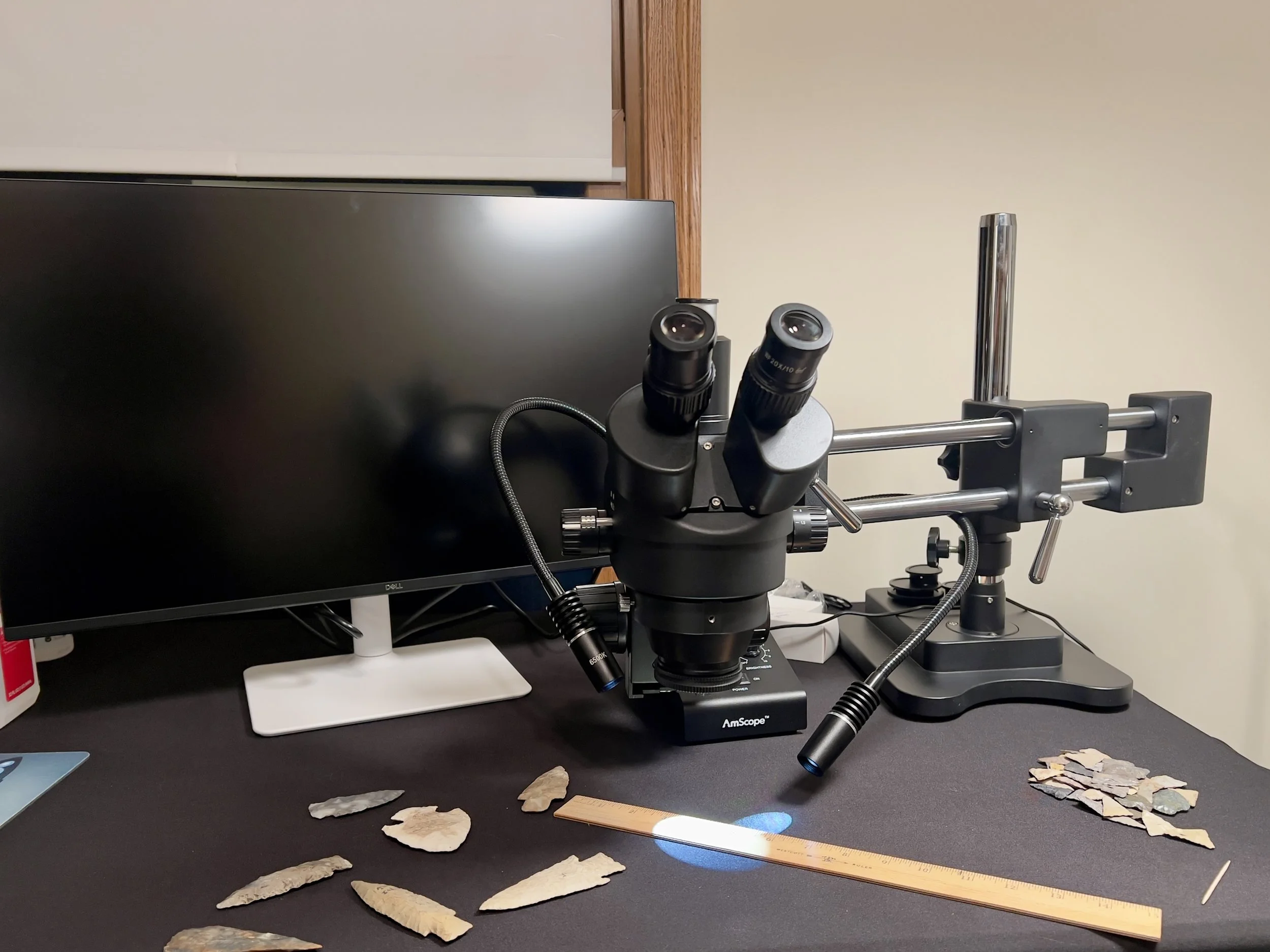
Artifact Evaluation Workstation with Trinocular Stereo Microscope
A trinocular AmScope SM-4TZZ-B stereo zoom microscope on an adjustable boom arm with dual gooseneck lighting and a camera feeding live view to a Dell monitor. The setup allows safe handling, directional lighting, and real-time documentation during artifact evaluation.
There may be no more rewarding hobby than collecting relics of North America’s prehistoric inhabitants. To handle, speculate on, and evaluate these pieces is nothing short of fascinating. It is a direct way to connect with history in a tangible and meaningful way. However, this same hobby is also flooded with deceptive reproductions, modern tooling, right alongside high quality authentic pieces that can be worth thousands of dollars. Because of that reality, having the right tools to make sound judgments is essential.
Through our experience testing and using a wide range of equipment for artifact evaluation, we have learned what genuinely enhances the inspection process and what ultimately falls short. What follows is a shared account of what has worked well, what has not, and how selecting the right equipment can help you become a more confident and accurate evaluator.
Equipment choice matters, but it must begin with knowledge. Before investing in any tool, a collector should first understand what they are actually looking for under magnification. There is excellent collector literature available that outlines common indicators of both authentic and inauthentic relics. Immersing yourself in this information builds a necessary foundation. Knowing the difference between authentic surface features and glued on debris or deceptive deposits is critical. Once that knowledge is in place, equipment becomes a way to support and confirm what an informed eye already understands.
When identifying the key requirements of an effective evaluation tool, a few elements consistently stand out. True depth perception is essential. You need a tool that allows you to see artifacts and their details in genuine three dimensions. Adjustable lighting is equally important. Being able to control both the angle and intensity of light helps reveal subtle surface features that would otherwise go unnoticed. A spacious workspace beneath the lens is also critical, allowing the artifact to be rotated and examined from multiple orientations. Finally, the ability to document findings is indispensable. Whether through a camera port or a dedicated imaging setup, documentation ensures evaluations are repeatable and verifiable.
Magnification is another area where misconceptions are common. Higher magnification numbers do not automatically lead to better inspection. A practical magnification range of roughly 10x to 150x is useful, but most meaningful evaluation occurs in the mid range. Beginning with a baseline inspection at moderate magnification provides essential context for the piece as a whole. Zooming in too far too quickly often isolates tiny details and removes them from their broader setting, making interpretation more difficult rather than clearer.
For initial inspections, I typically work around 20x. This provides a broad, contextual view while still revealing important features. Higher magnifications are helpful when closer scrutiny is required, but they are secondary to having a reliable and clear mid range. It is also important to emphasize the difference between true optical zoom and digital zoom. Digital magnification often inflates numbers without adding real clarity and can mislead more than it informs.
This distinction becomes especially apparent when comparing stereo microscopes to digital microscopes. Digital microscopes can be misleading, particularly at lower price points. To achieve the same clarity and depth perception offered by a quality stereo microscope, a digital setup often requires a significant financial investment. While the internet is full of digital microscopes promising impressive specifications, many fail to deliver consistent or reliable results. When evaluating high end relics, it is important that your equipment matches the caliber of the material being examined. Reliability and depth perception should always outweigh flashy claims.
Lighting plays a major role in achieving that reliability. In many cases, upgrading lighting has a greater impact on evaluation quality than increasing magnification. Gooseneck lighting allows light to be angled and controlled in a way that brings out texture and depth. This makes it far easier to identify subtle surface features and distinguish between dimensional deposits and flat surface staining. Ring lighting, which is often bundled with microscopes, tends to flatten the image and obscure fine details. Directional lighting consistently provides a clearer and more accurate view.
Stability and workspace design are also worth careful consideration. A comfortable, open setup allows the artifact to be examined naturally and safely. I personally prefer a stereoscope with an adjustable boom arm, where the optics move over the artifact rather than placing the piece on a fixed platform. Many stationary platforms are made from materials that can scratch or damage relics and often require additional padding. A boom arm setup allows the artifact to remain stable while the optics are repositioned, providing flexibility without unnecessary risk.
Regardless of the equipment used, documenting findings remains one of the most important parts of the evaluation process. This is especially true when creating catalogs or preparing artifacts for sale. Recording the important details you observe ensures that someone else examining the piece later can see the same features under similar conditions. An evaluation is only as valuable as the record that accompanies it, so careful documentation should always be part of the process.
In the end, tools support judgment, but knowledge and honesty remain key. Approaching each artifact with an informed and objective eye is essential. Developing that eye means studying not only high quality relics but also broken, damaged, or inauthentic pieces. Understanding the differences between ancient workmanship and modern fabrication is critical, especially under magnification. Just as these differences can be recognized with a piece in hand, they must also be identifiable at the microscopic level. An informed eye, supported by the right tools, is what ensures evaluations remain trustworthy and accurate.